I entered Zhejiang University in 2022—just as GPT-3.5 reshaped the world—and have been fortunate to explore the frontiers of AI ever since. Over the past 2 years, my research centered on speech processing and healthcare, where I worked with Prof. Gopala Anumanchipalli and Dr. Jiachen Lian at UC Berkeley (Berkeley Speech Group / BAIR) and contributed to the Qwen Omni team at Alibaba. I am now applying deep learning to quantitative finance.
🔥 News
- 2025.05: 🎉🎉 My first-author paper Dysfluent WFST: A Framework for Zero-Shot Speech Dysfluency Transcription and Detection is accepted by Interspeech2025!
- 2026.01: 🎉🎉 My co-first-author paper K-Function: Joint Pronunciation Transcription and Feedback for Evaluating Kids Language Function is accepted by ICASSP 2026!
- 2026.09: 🎉🎉 My co-first-author paper HuPER: A Human-Inspired Framework for Phonetic Perception is accepted by NeurIPS 2026!
📝 Selected Publications

Dysfluent WFST: A Framework for Zero-Shot Speech Dysfluency Transcription and Detection
Chenxu Guo, Jiachen Lian, Xuanru Zhou, Jinming Zhang, Shuhe Li, Zongli Ye, Hwi Joo Park, Anaisha Das, Zoe Ezzes, Jet Vonk, Brittany Morin, Rian Bogley, Lisa Wauters, Zachary Miller, Maria Gorno-Tempini, and Gopala Anumanchipalli (2025).
- A novel framework for zero-shot speech dysfluency transcription and detection, leveraging weighted finite-state transducers (WFST) to handle dysfluencies in speech data.
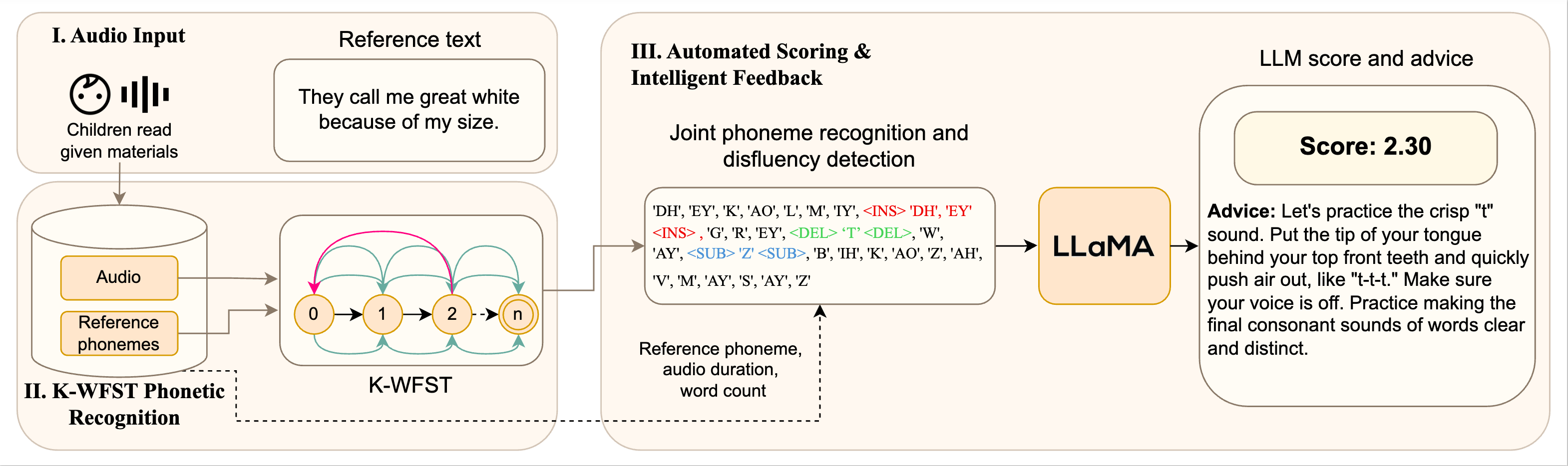
K-Function: Joint Pronunciation Transcription and Feedback for Evaluating Kids Language Function
Shuhe Li*, Chenxu Guo*, Jiachen Lian, Cheol Jun Cho, Wenshuo Zhao, Xiner Xu, Ruiyu Jin, Xiaoyu Shi, Xuanru Zhou, Dingkun Zhou, Sam Wang, Grace Wang, Jingze Yang, Jingyi Xu, Ruohan Bao, Xingrui Chen, Elise Brenner, Brandon In, Francesca Pei, Maria Luisa Gorno-Tempini, and Gopala Anumanchipalli (2025).
* Equal contribution.
- A comprehensive framework for evaluating children’s language function.
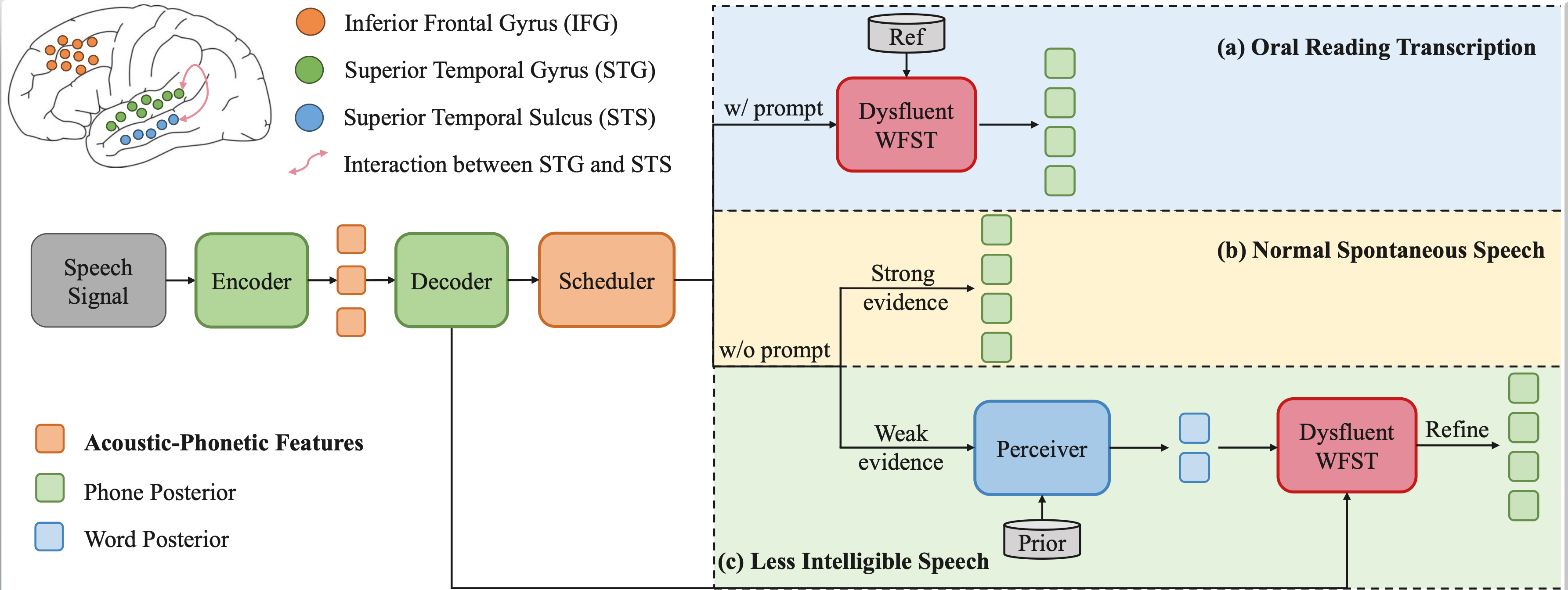
HuPER: A Human-Inspired Framework for Phonetic Perception
Chenxu Guo*, Jiachen Lian*, Yisi Liu, Baihe Huang, Shriyaa Narayanan, Bixing Wu, Zoe Ezzes, Jet Vonk, Zachary Miller, Cheol Jun Cho, Maria Gorno-Tempini, and Gopala Anumanchipalli (2026).
* Equal contribution.
- HuPER is a human-inspired, evidence-controlled multi-path framework that integrates bottom-up acoustic–phonetic modeling with explicit top-down linguistic constraints.
📖 Education

Zhejiang University
Hangzhou, China
B.Eng. in Electronic Information Engineering
Sep 2022 – Jul 2026💻 Experience

Hangzhou Asian Games
Hangzhou, China
Volunteer
Sep – Oct 2023Supported event operations during the 2022 Asian Games in Hangzhou.

Berkeley Artificial Intelligence Research (BAIR)
Berkeley Speech Group · University of California, Berkeley
Visiting Student Researcher
Sep – Dec 2025Proposed and co-led HuPER, a framework that combines acoustic evidence with linguistic knowledge to model how people perceive speech sounds.
Trained on 100 hours of speech, HuPER achieved state-of-the-art phonetic feature error rates on five English benchmarks and transferred to 94 unseen languages without additional training.
Paper · NeurIPS 2026 poster · Co-first authorResearch Intern
Jul 2024 – Sep 2025Developed Dysfluent WFST, a zero-shot decoder that transcribes phonemes and detects speech dysfluencies in one pass. UCSF integrated it into its AI pipeline for diagnosing primary progressive aphasia.
Interspeech 2025 oral paper · First authorResearch advisors · Prof. Gopala Krishna Anumanchipalli and Dr. Jiachen Lian

Qwen Omni, Alibaba
Beijing, China
Algorithm Engineer Intern
Feb – Jul 2026Core contributor to phone-level speech perception in Qwen3.8-Omni-Flash-Realtime, enabling the model to recognize individual speech sounds and assess pronunciation during real-time speaking practice.
Product launchMentors · Dr. Jin Xu and Zhifang Guo